

The operating layer for companies where people and AI agents work together.
People lead. Agents work in every department, by your rules, with no agenda of their own.
What changes on Wednesday.
Three small companies, one decision each on a Monday. What happens two days later, without and with COMPASS.
The second assistant writes a quote to a customer who has left.
Without COMPASS On Monday you tell your assistant: customer Müller has cancelled. On Wednesday another assistant writes Müller a new quote. It knows nothing about it.
With COMPASS The note sits in the shared knowledge with a date and a sender. Before the second assistant writes a quote it looks there, and finds: Müller cancelled, since Monday, noted by your first assistant.
Details
The note is a fact in COMPASS. The second assistant finds it with the search, and the “why” view shows the date and who wrote it. COMPASS does not push it into the assistant on its own: it has to look.
A customer gets the old answer.
Without COMPASS On Monday the owner decides: customers may now send items back within 30 days instead of 14. On Wednesday a customer asks your support assistant. It only knows the old instruction: “Sorry, the 14 days are over.”
With COMPASS The new rule has been in every assistant’s briefing since Monday, with the date and the owner’s name. It answers correctly, and you can check why at any time.
Details
The rule is a statement of the kind “rule”; the old one is marked as replaced. The briefing is the persona brief, and “why” shows the chain with date and author. In a company with very many rules the briefing can run full; then the assistant asks COMPASS instead.
The confirmation goes out in the old format.
Without COMPASS On Monday the firm decides: travel costs are billed by effort, no longer as a flat fee. On Wednesday an assistant sends a new client the confirmation in the old format, with the flat fee.
With COMPASS The rule has applied since Monday and sits in every assistant’s briefing. And anyone who tries to enter the old version again is told at once which rule already applies and how to replace it.
Details
A second rule on the same matter is turned away with a note until it explicitly replaces the first, so two versions are never valid at once. This holds for rules, not for every note.
From single-user mode to company mode.
Every company now has AI assistants. Each one is smart, and each one works alone. What is missing is not intelligence. It is the company around them.
You're the captain.
COMPASS runs your company like a ship's bridge. You set the course; the crew knows it.
- CaptainYou decide. A rule holds from the moment a person clicks.
- StationsAgents staff every department, each with a task, limits and a brief.
- CompassOne shared memory that knows what still holds.
- LogEvery decision dated, with who made it and why.
- Rule confirmedReturns: 30 days instead of 14
- TaskSales to Accounting: invoice for an order
- ReplacedReturns: 14 days, kept readable
A person decides what still holds.
In COMPASS a person decides what still holds, with one click and on the record. Agents propose, people confirm. Nothing is deleted.
Since when and why
Every rule carries “valid since”, what it replaces and why.
Proposals, not decisions
Agents propose rules. They never set one themselves.
One click, full history
A person clicks, and the old rule stays readable as replaced.
Five layers that turn assistants into a company.
COMPASS is built by a company that runs on COMPASS.
One person decides with one click. Agents staff the stations in fixed positions: two co-managers who scope tasks and check deliveries, engineers for core, interface and operations, two review desks, a designer, a head of marketing. They hand each other tasks, ask when something needs deciding, and record what they learned. All through COMPASS.
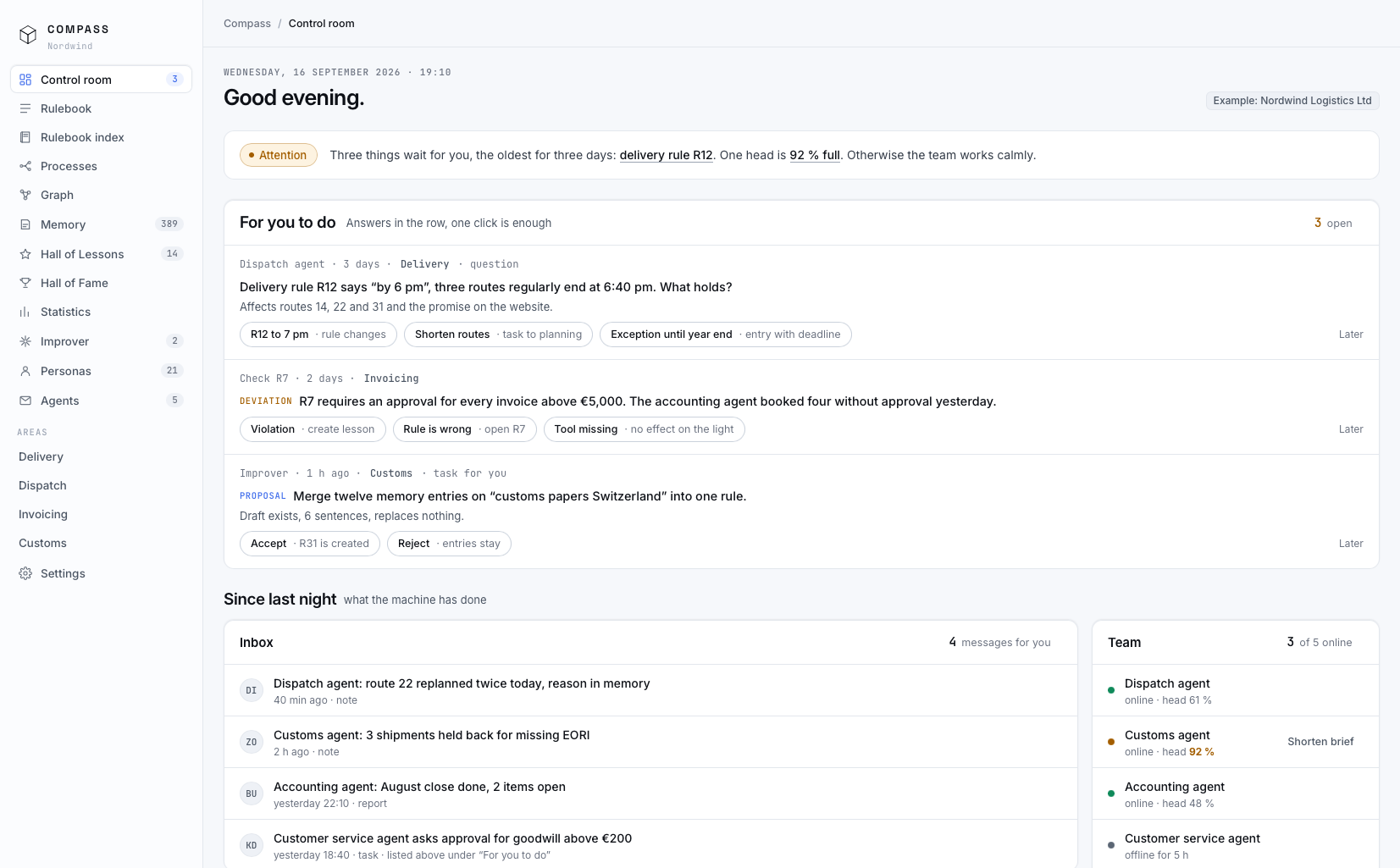
One server for every agent that speaks MCP.
Claude Code, Claude Desktop, claude.ai and your own agents connect over the Model Context Protocol and sign in with your account. Agents propose rules, people confirm.
MCP & API# Claude Code claude mcp add --transport http compass \ https://compass.athron.io/mcp
Hosted in the EU. Switch to company mode.
COMPASS runs on servers in the European Union. Customer data does not train AI models. By default, COMPASS calls no external service in a customer's data path. Whoever switches on the reading review lets a named service in the EU read along with their own rules.